 RCIC News.
Canada's immigration system now favors French speakers over higher-scoring English candidates
On This Page You Will Find:
- Why 48,000 French speakers bypassed higher-scoring English candidates in 2024
- The shocking score gaps that reveal Canada's new immigration priorities
- How non-French speakers are fighting back (including one student's desperate strategy)
- What the 157,215 stuck candidates need to know about their real chances
- The economic debate tearing apart Canada's immigration system
Summary:
Canada's immigration system has fundamentally shifted, with French-speaking applicants now claiming 42% of all Express Entry invitations despite often scoring hundreds of points lower than English-only candidates. This seismic change has created a two-tiered system where speaking French can matter more than education, work experience, or overall qualifications. With permanent resident spots shrinking from 485,000 to 380,000 by 2026, the competition has never been fiercer—and the rules have never been more controversial. If you're navigating Canada's immigration maze, understanding this new reality could mean the difference between success and years of waiting.
🔑 Key Takeaways:
- French speakers secured 48,000 of 113,998 Express Entry invitations in 2024 (42%)
- Francophone draws accept scores as low as 379, while 157,215 candidates score above 400
- Canada plans to increase French-speaking immigration from 6% to 12% by 2029
- Non-French candidates with 500+ scores are being passed over or leaving Canada
- Learning French now adds 50 points and access to easier immigration pathways
Picture this: You've spent years building the perfect immigration profile. Master's degree? Check. Canadian work experience? Check. IELTS score of 8.5? Check. Your Comprehensive Ranking System (CRS) score sits at a solid 485 points. You should be golden, right?
Wrong.
While you're waiting months for an invitation that may never come, someone with a 399 CRS score just received their permanent residence invitation—simply because they speak French.
Welcome to Canada's new immigration reality, where language politics has turned the merit-based system upside down.
The Numbers That Tell the Shocking Story
In 2024, something unprecedented happened in Canadian immigration. Of the 113,998 people invited through Express Entry, a staggering 48,000—or 42%—were selected specifically because they spoke French. These weren't necessarily the highest scorers. In fact, many had scores that would make traditional applicants cringe.
The most recent francophone draw in December issued 6,000 invitations with a cut-off score of just 399 points. Meanwhile, 157,215 candidates sitting in the general pool had scores above 400, watching helplessly as lower-scoring French speakers leap-frogged ahead of them.
To put this in perspective: if you're an English-only speaker with a 450 CRS score, you're statistically more likely to win a lottery ticket than receive an immigration invitation under the current system.
How We Got Here: The 2023 Game-Changer
The earthquake started in 2023 when then-Immigration Minister Sean Fraser introduced "category-based selection"—bureaucratic speak for "we're picking favorites." This system created separate lanes for different types of candidates, with French speakers getting their own express highway while everyone else fights for scraps on the regular road.
The justification? Protecting French-speaking communities outside Quebec, whose population has dropped from 6.1% in 1971 to about 4% today. Noble goal, perhaps, but the execution has created what critics call a "lottery system" that ignores economic merit.
Here's what makes this particularly painful: Canada simultaneously slashed overall permanent resident intake from 485,000 in 2024 to 380,000 by 2026. Fewer spots, more French speakers getting priority—you do the math.
The Real-World Impact: Dreams Deferred and Departures
The human cost of this policy shift is becoming increasingly visible. Take Sara Xie, an international student in London, Ontario, who came to Canada from China in 2017. Despite earning her education here and working in healthcare, she's now spending hours daily learning French—not because she needs it for work, but because it's her only realistic path to permanent residence.
"Learning a language is supposed to be for communication, but here we rarely use French in our workplace or in our day-to-day life," Xie explains, capturing the absurdity many feel about the current system.
Vancouver immigration lawyer Catherine Sas has watched three clients with master's degrees and 500+ scores struggle unsuccessfully for permanent residence. One has already left Canada entirely—a brain drain the country can ill afford.
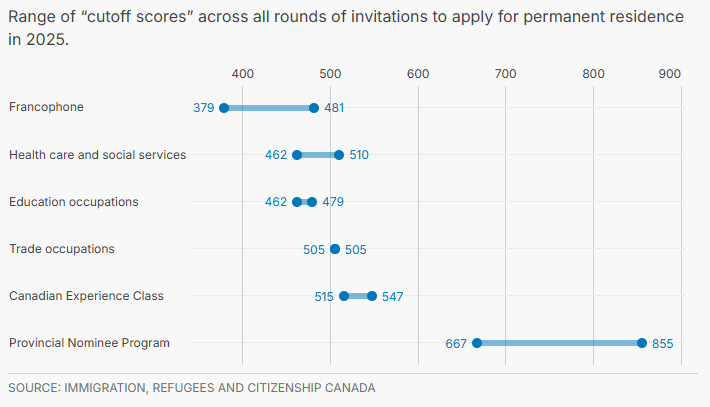
The Score Comparison That Says Everything
The numbers reveal the stark reality of Canada's two-tiered system:
Francophone Draws (2024):
- 9 draws selecting 48,000 people
- Score range: 379-481 points
- Average in the low 400s
Healthcare Worker Draws (2024):
- 7 draws selecting 14,500 people
- Score range: 462-510 points
- Consistently higher requirements despite critical labor shortages
General Draws:
- Virtually non-existent
- 157,215+ candidates with 400+ scores still waiting
The message is clear: in today's Canada, speaking French matters more than being a healthcare worker during a staffing crisis.
The Economic Argument Falls Apart
Immigration consultant Mandeep Lidher doesn't mince words: "Human capital really isn't a concern for the francophone draws. With a score in the high 300s, you're definitely less educated and you could say less likely to succeed in the Canadian labour market."
This critique hits at the heart of Express Entry's original purpose: selecting immigrants most likely to contribute economically. When language preference overrides education, work experience, and demonstrated ability, the system stops being about economic benefit and becomes about cultural engineering.
The irony deepens when you consider the job market reality. A recent Immigration Department study found that francophones face significant challenges accessing services and jobs outside Quebec. As immigration lawyer Catherine Sas points out: "They won't get jobs unless they go to Quebec, and remember this program is for people outside of Quebec."
The C.D. Howe Institute Sounds the Alarm
Last month, five Canadian economists published a scathing policy brief that called out the new system's fundamental flaws. Their assessment? The discretion-based selection has created "an opaque system that is exposed to political lobbying, looks like a lottery to prospective migrants, and squeezes out highly skilled candidates."
The economic consequences extend far beyond individual disappointment: "Admitting fewer skilled immigrants reduces our country's productivity and tax revenue making it harder to fund social programs."
When economists start warning about productivity losses and reduced tax revenue, you know the policy has moved beyond cultural preservation into economic self-harm territory.
What This Means for Your Immigration Strategy
If you're currently in the Express Entry pool or planning to enter, here's your brutal reality check:
If you only speak English:
- Your chances of invitation have plummeted, regardless of your score
- Scores above 500 no longer guarantee anything
- You're competing for an increasingly smaller slice of available spots
If you're willing to learn French:
- 50 additional CRS points for intermediate proficiency
- Access to francophone draws with much lower cut-off scores
- Multiple pathways including new student and worker programs
The French Advantage Package:
- Relaxed work permit requirements (no job offer needed)
- Lower language proficiency requirements for work permits
- Direct permanent residence pathway for French-speaking students
- Easier financial requirements for study permits
The Political Reality Behind the Numbers
Immigration Minister Lena Metlege Diab made the government's priorities crystal clear in November: "We have an ambitious francophone immigration plan, which we will attain. We are working on global talents, attracting the best of the world."
Notice the order: francophone plan first, global talent second. This isn't accidental phrasing—it's policy priority made explicit.
The plan calls for increasing French-speaking immigration outside Quebec from 6% to 9% by 2026, and 12% by 2029. With overall immigration numbers dropping, this means an even larger share of a shrinking pie going to French speakers.
The Questions Nobody Wants to Answer
Toronto immigration lawyer Shoshana Green poses the uncomfortable question: "How do we as a country attract sophisticated individuals, high-quality individuals when there's no chance for them to come if English is their only language?"
Catherine Sas frames the broader dilemma: "Are we striking the right balance between cultural goals versus economic needs? One needs to go back to the government, the immigration minister or the prime minister to get them to answer that."
So far, those answers haven't come. Instead, we get bureaucratic responses about "top-ranking eligible candidates" and "economic establishment"—language that obscures rather than clarifies the fundamental trade-offs being made.
Your Next Steps in This New Reality
The Express Entry system you thought you understood no longer exists. The merit-based, points-driven selection has been replaced by a preference system that prioritizes cultural and political goals over economic contribution.
If you're serious about Canadian immigration, you have three realistic options:
-
Learn French immediately - Start today, not tomorrow. Intermediate proficiency takes 6-12 months of dedicated study but opens doors that remain firmly closed to English-only speakers.
-
Explore Provincial Nominee Programs - Some provinces still prioritize skills over language politics, though this is changing rapidly.
-
Consider alternative destinations - Australia, New Zealand, and other countries still operate merit-based systems that reward qualifications over language politics.
The hardest truth? The Canada that marketed itself as a meritocratic destination for global talent has fundamentally changed. Whether this transformation serves the country's long-term interests remains to be seen, but for individual applicants, adaptation isn't optional—it's survival.
The 157,215 candidates sitting above 400 points represent more than statistics. They're dreams deferred, careers interrupted, and families separated by a system that changed the rules mid-game. Some will learn French and eventually succeed. Others will leave for countries that still value their skills over their language preferences.
The choice—and the consequences—are now entirely yours.
